Industrial Epoxy Flooring in Broward County
Heavy-duty, chemical-resistant floor systems for Broward's warehouses, food and beverage plants, marine shops, and fleet bays — engineered for coastal humidity, salt air, and a high water table.
Industrial Floors Built for Broward's Salt Air, Humidity, and High Water Table
Broward County's industrial backbone runs through the inland edge of the county — the warehouse rows off I-595 and Powerline Road, the distribution parks around Port Everglades and Fort Lauderdale Executive Airport, the light-manufacturing and marine-trade shops of Pompano Beach, Davie, and Deerfield Beach. Every one of these buildings shares the same enemy underfoot: a concrete slab poured close to a coastal water table, breathing humid salt air year-round, and pushed hard by forklifts and washdowns. That combination chews through bare concrete and consumer-grade coatings far faster than a facility manager expects.
A floor here has to survive what makes Broward, Broward. Saltwater humidity drifting in off the Atlantic and the Intracoastal carries chloride that pits unprotected slabs and rusts embedded rebar from below. The shallow coastal water table drives constant vapor pressure up through the concrete — the single biggest reason coatings blister and peel in South Florida. And from June through October, afternoon storms and the wet-season air mean a slab is rarely truly dry. We engineer around all three: vapor-tolerant primers, moisture-mitigation systems, and chemistry that bonds to a humid substrate instead of fighting it.
For Broward's real industrial mix — warehousing and 3PL logistics, food and beverage and seafood processing, marine and boat-repair shops serving the canal and yachting communities, auto and fleet maintenance, plus the light manufacturing that supplies all of it — we match the system to the job: chemical-resistant coatings for wash and process areas, urethane cement for thermal-shock and food zones, impact-rated build for forklift aisles, and ESD systems for electronics and battery work. This is heavier-duty work than our commercial epoxy flooring, which is built for retail and office traffic rather than 24/7 industrial loads.
Running a showroom, office, or hospitality space instead of a plant? Our commercial epoxy flooring service is the right fit.
What a Broward Industrial Floor Has to Beat
Coastal humidity, salt-air corrosion, washdown chemicals, and around-the-clock forklift loads — here is how the right system handles each.
100+
Chemical & Washdown Resistant
Stands up to the cleaners, sanitizers, oils, and process chemicals a Broward facility deals with daily — from caustic sanitation in a food or seafood plant to battery acid in a fleet shop. We spec standard or novolac systems to your actual chemical list, and to the constant freshwater-and-salt rinse cycles coastal facilities run.
10,000+ lbs
Forklift & Heavy Machinery Rated
Takes the constant turning, point loads, and abrasion of forklifts, pallet jacks, and loaded racking without cracking or delaminating — the kind of duty the 3PL and distribution warehouses off I-595 and around Port Everglades run every shift, around the clock.
OSHA
Slip-Safe in Wet Conditions
Anti-skid aggregate and high-traction topcoats keep footing safe where Broward floors stay wet — washdown bays, food-prep zones, and entries that track in rainy-season runoff and humidity. Meets OSHA slip-resistance standards so a damp floor never becomes a workers'-comp claim.
Custom
Safety Line Marking
Forklift aisles, pedestrian walkways, hazard zones, dock-edge warnings, and equipment footprints laid out and color-coded into the floor itself — applied in durable epoxy that won't lift under the wheel traffic and washdowns of a busy Broward warehouse.
ESD
Anti-Static (ESD) Options
Conductive and dissipative ESD systems for the electronics assembly, marine-electronics, and lithium-battery and fleet-charging work growing across Broward — where static is a real hazard. Meets ANSI/ESD standards while still handling the area's humidity load.
10–20 yrs
Built to Last in a Coastal Climate
The reason industrial floors fail early in Broward isn't the traffic — it's moisture and salt attacking the bond from underneath. Get the slab prep, vapor mitigation, and chemistry right for this coast, and an industrial system runs for many years of hard service instead of peeling in a few. That is the entire difference between a one-time install and a recurring resurfacing bill.
How coastal humidity affects durability →How It Works
Five steps from bare slab to a production-ready floor — built around the moisture testing that makes or breaks a coating on Broward's coastal concrete. Phased so a working facility keeps running.
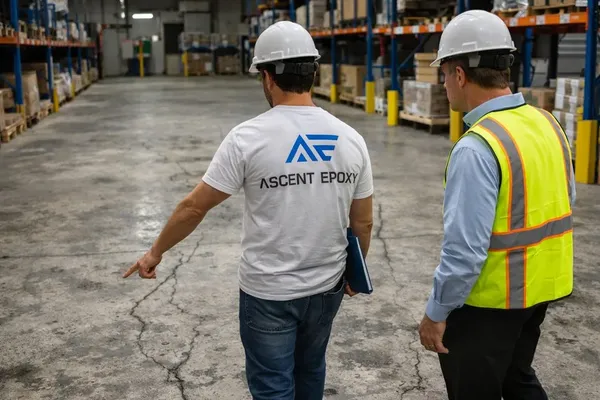
Facility Assessment
~Half dayWe walk the whole facility, map forklift lanes and wet zones, log every chemical it handles, and check the age and exposure of the slab — older coastal slabs and additions often read very differently. Where it sits relative to the water table tells us how aggressive the moisture plan needs to be. Schedule yours free.
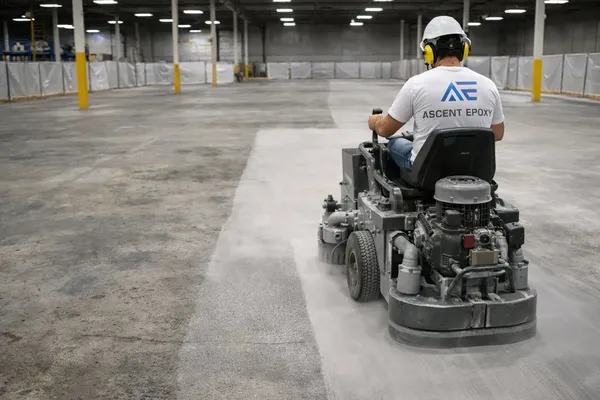
Industrial Slab Preparation
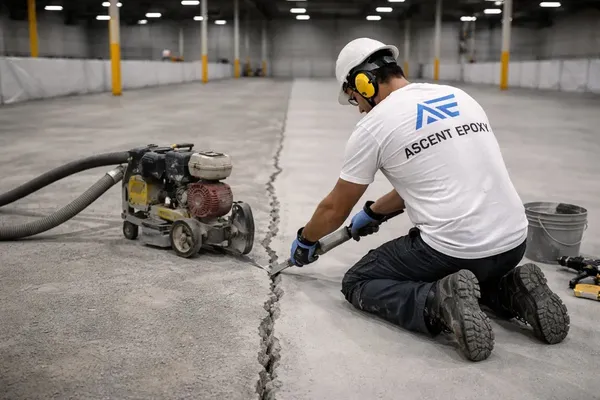
4–8 hrsDiamond grinding and shot blasting open up the slab to a real bonding profile — not a wipe-and-roll. On Broward slabs we also chase out the chloride-driven spalling and surface salt that coastal concrete builds up, then rout and fill every crack and control joint so nothing telegraphs through the finished floor.
Primer & Moisture Barrier
2–4 hrsThis is the step that decides whether a floor lasts in Broward. We test slab moisture with calcium-chloride and relative-humidity probes, and where the coastal water table is pushing vapor up — which is most sites here — we lay down a moisture-mitigation barrier before the industrial primer. Skip it and the floor blisters within a season; do it right and the bond holds for years.
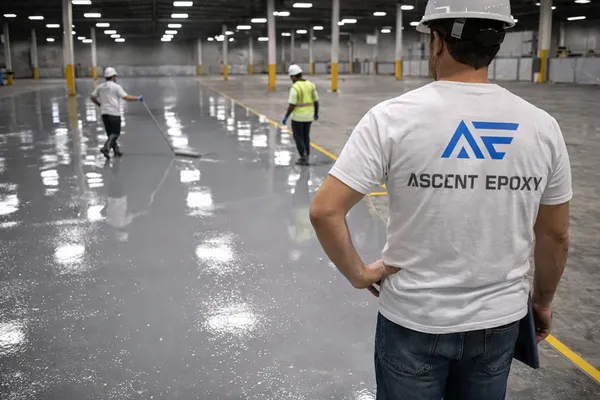
Epoxy System Application
1–3 daysThe build coats go down to the spec the assessment called for — urethane cement in food and washdown zones, chemical-resistant or novolac in process areas, high-build impact-rated in forklift aisles, or ESD where static matters. Forklift lanes, walkways, dock warnings, and anti-skid aggregate for wet footing are integrated as we go, not bolted on after.
Curing & Handoff
3–7 daysWe control the cure — watching temperature and the humidity that South Florida air pushes into a building — then check hardness and adhesion before we hand it back. Your team gets maintenance guidelines written for this coating and this facility, including how to clean it without breaking down the finish in a salt-and-washdown environment.
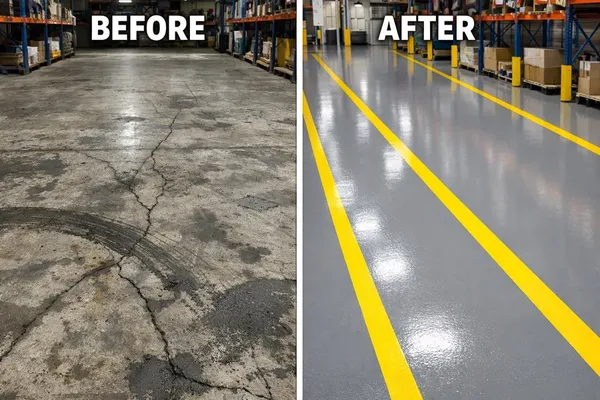
Ready to Start? Step 1 Is Free.
Schedule your no-obligation consultation and see finish samples in your space.
Industrial Epoxy Projects
Real installations in Broward County warehouses and industrial facilities.
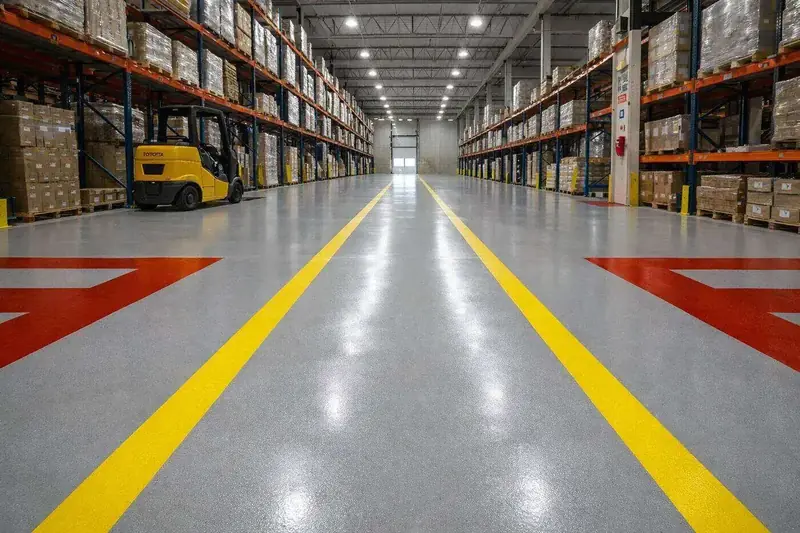
Systems We Install for Broward Facilities
Warehousing, food and beverage, marine trades, fleet shops — each one needs a different floor. We match the system to the work, the chemicals, and the coastal slab underneath it.
Urethane Cement Flooring
Urethane cement is the toughest floor we install — built for the rooms where standard epoxy simply gives up. It bonds tight to concrete and shrugs off thermal shock: the hot-water sanitation and steam cleaning, the chemical washdowns, the swing from a chilled cooler to a hot kitchen line. Just as important on this coast, it tolerates moisture in the slab better than most systems, which matters when the water table sits close beneath the floor.
That makes it the natural pick for Broward's food and beverage and seafood processors, commercial kitchens and breweries, and cold-storage and meat rooms — anywhere the floor is washed down daily and never really dries out. It cures fast and returns to service quickly, so a working line is back up without a long shutdown.
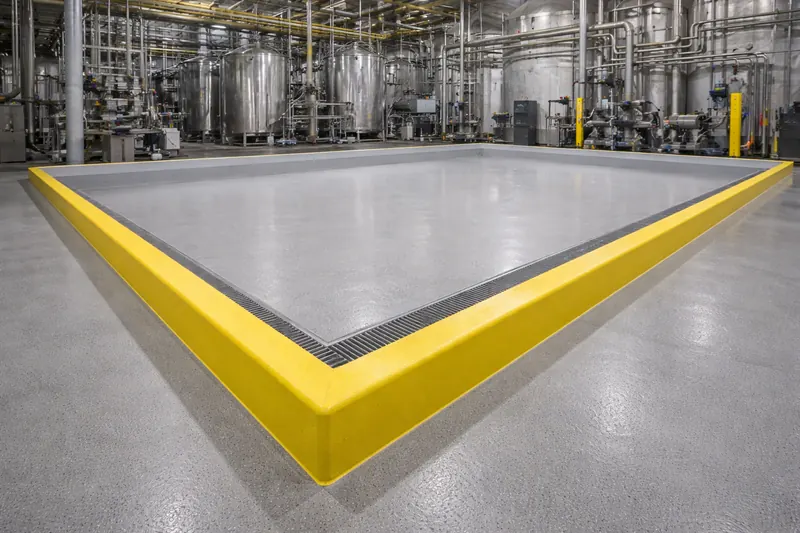
Warehouse Floor Coatings
Broward's distribution and 3PL warehouses — the rows off I-595 and Powerline Road, the logistics parks feeding Port Everglades and the cargo side of the airport — put more daily load on a floor than almost anything else. Forklifts pivot on the same spots, pallet jacks drag across the surface, and racking concentrates tons onto tiny footplates. Add coastal humidity and a bare slab dusts, cracks, and fails faster than most warehouse managers plan for.
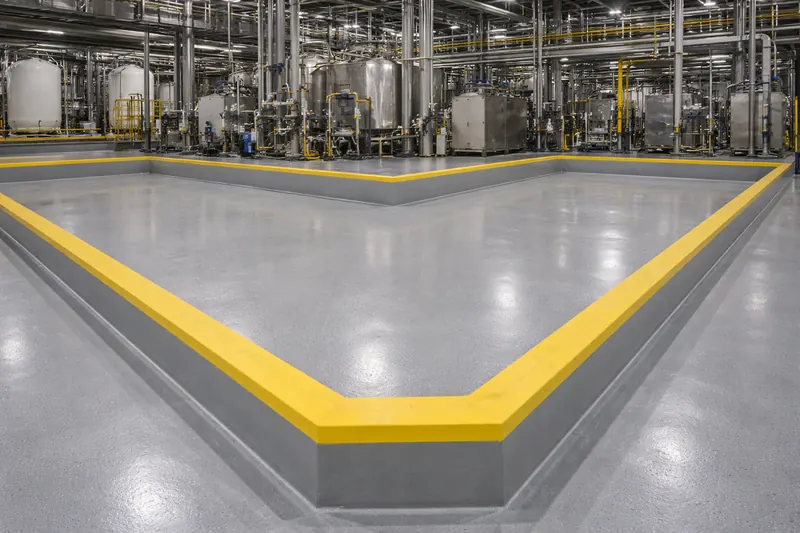
We build these floors in high-build epoxy with abrasion-resistant topcoats rated for that traffic, and we lay the aisle striping, pedestrian zones, and dock-edge color coding into the system rather than painting it on later. Because most of these buildings can't shut down, we phase the work zone by zone so racking stays loaded and trucks keep moving while we coat the rest.
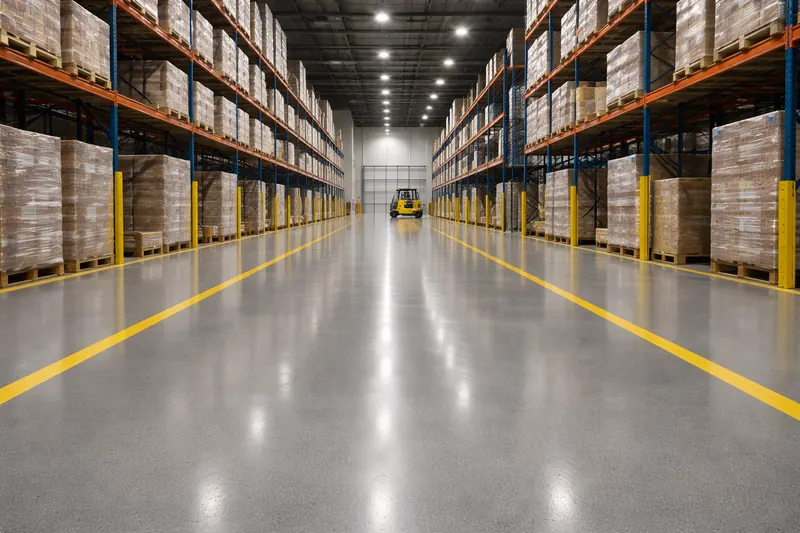
Secondary Containment Areas
Plenty of Broward facilities store or handle materials that legally can't be allowed to reach the ground — fuel and oil at marinas and boatyards, diesel for standby generators and fleet fueling, and the chemical and solvent stores behind manufacturing and service shops. Here the stakes are environmental as much as regulatory: a spill that escapes containment can run straight into canals, the Intracoastal, and the shallow aquifer that sits just below the surface across the county.
We install chemical-resistant containment coatings with integrated curbing and berms that keep a leak inside the room and out of the storm drains and waterways. Systems are sized to hold the volume the applicable code requires, and the coatings stand up to acids, bases, fuels, and solvents — sealed tight against a slab that, this close to the coast, is fighting moisture from below at the same time.
Rated 5.0★ — Broward County Reviews
Real reviews from real Broward County clients — verified on Google.
"Had my garage done by Ascent Epoxy Broward this spring. The crew showed up on time, explained everything clearly, and finished in two days. The floor looks incredible—smooth, glossy, and easy to clean. You can tell they take pride in their work. Definitely recommend if you're in Broward."
"We had them do epoxy in our shop in Coral Springs. Super happy with the result and how quickly they finished. Looks way more professional now."
"Friendly guys, fast service, and the floor turned out perfect. Would hire again."
Industrial Epoxy Flooring FAQs — Broward County
Common questions about industrial epoxy flooring for Broward County facilities.
We install industrial epoxy flooring in a wide range of facilities across the Broward County metro area, including:
- Warehouses and distribution centers
- Manufacturing plants
- Chemical processing facilities
- Food and beverage processing plants
- Maintenance bays and service shops
- Control rooms and clean environments
Our systems are engineered to handle the specific demands of each facility type, from chemical resistance in processing plants to impact resistance in high-traffic warehouses.
Broward County's average 74% humidity is critical for large industrial slabs. Moisture trapped beneath the coating causes delamination and peeling, and on expansive warehouse floors, even small moisture variations can affect thousands of square feet.
We perform comprehensive moisture testing across the entire slab using calcium chloride and relative humidity probe methods. When readings are elevated, we apply moisture-mitigating primers and vapor barrier coatings before the epoxy system goes down. We also schedule installation windows around optimal humidity conditions to ensure a lasting bond.
Yes. Our industrial epoxy systems are formulated with chemical-resistant resins that withstand exposure to a wide range of substances, including acids, alkalis, solvents, petroleum products, oils, and fuels.
We offer various chemical resistance ratings depending on the specific chemicals present in your facility. Standard epoxy handles oil, grease, and mild chemicals. For facilities along the petrochemical corridor that deal with concentrated acids and harsh solvents, we install novolac epoxy systems with the highest chemical resistance ratings available.
Yes. We install OSHA-compliant safety line marking as part of our industrial epoxy flooring systems. This includes:
- Pedestrian walkways
- Forklift traffic lanes
- Hazard zones and restricted areas
- Equipment placement boundaries
- Emergency exit paths
- Color-coded area designations
All markings are applied with durable epoxy paint that bonds directly to the floor system and withstands heavy daily traffic without fading or peeling.
Industrial epoxy installation typically takes 3 to 7 days depending on the facility size, condition of the existing concrete slab, and complexity of the coating system required.
For larger facilities, we offer phased installation that allows you to keep portions of your operation running while we work on other sections. This minimizes downtime and keeps your production schedule on track. We provide a detailed project timeline during the estimate phase so you can plan around the installation.